
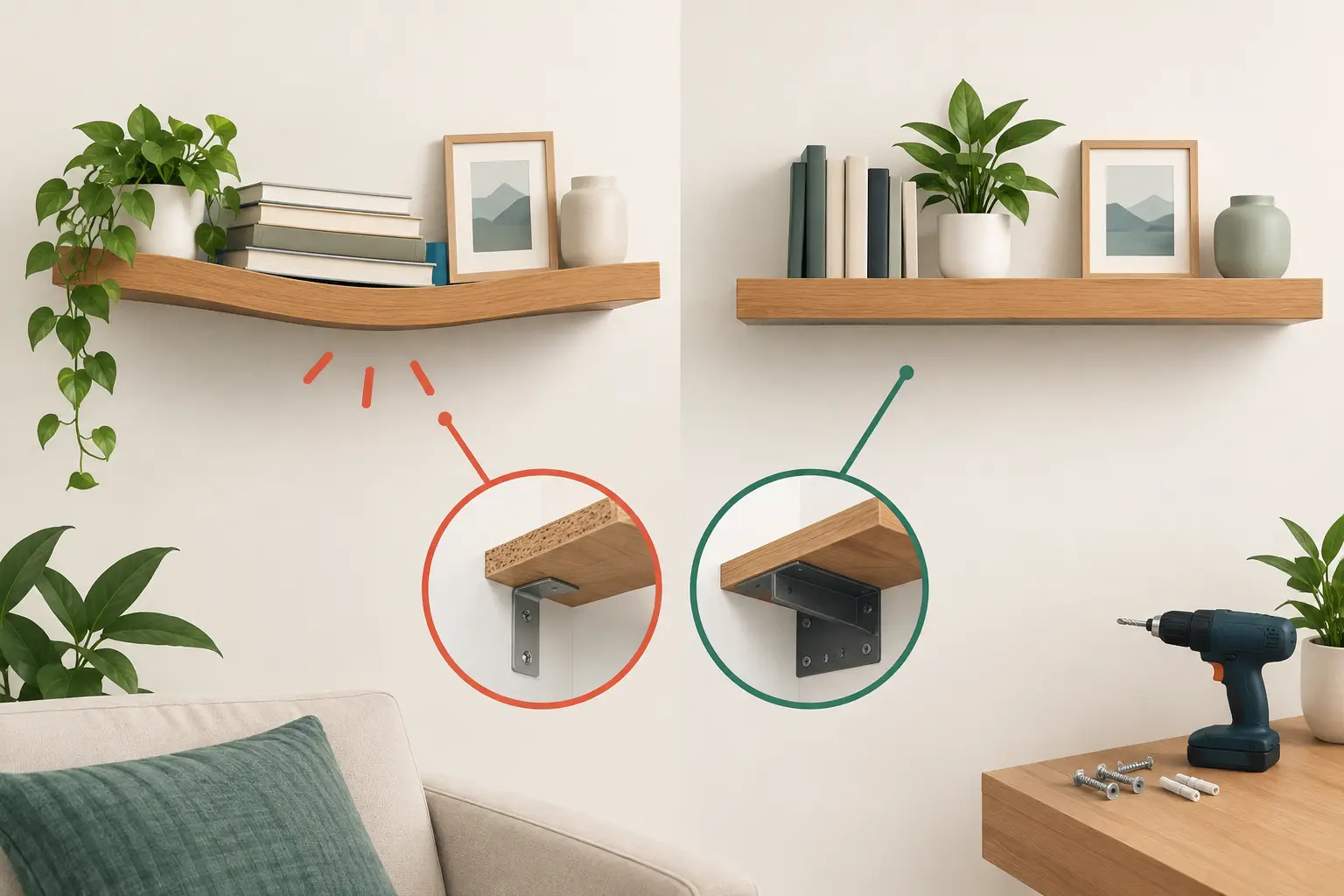
A floating shelf that looks perfectly level on installation day but starts to dip months later is frustrating – especially when it holds the pieces that make a room feel finished. So, do floating shelves sag? They can, but sagging is not an unavoidable part of owning them. It is usually the result of a shelf that is too thin, too long, overloaded, poorly mounted, or built around hardware that cannot carry the intended weight.
A well-made solid wood floating shelf, sized for its span and installed into solid framing, should stay straight and dependable for years. The key is treating it like a structural piece of furniture, not just a decorative board with hidden brackets.
Why Do Floating Shelves Sag?
Most people use the word “sag” for two different problems. The first is wood deflection, where the shelf itself bends downward in the middle. The second is mounting failure, where the shelf or bracket shifts downward at the wall. They can look similar from across the room, but they call for different fixes.
Wood deflection happens when a shelf span is too long for its thickness and the weight placed on it. A 48-inch shelf holding a few framed photos has a very different job than a 48-inch shelf lined with cookbooks, stoneware, and serving bowls. Even hardwood has limits. The farther it extends between support points, the more leverage the load creates.
Mounting-related sag is often caused by fastening a heavy shelf into drywall anchors instead of wall studs, using undersized floating-shelf rods, or failing to secure the mounting plate tightly and level. A shelf can be beautifully built and still perform poorly if the hardware is not matched to the wall and the expected load.
There is also a third issue that gets mistaken for sag: natural wood movement. Solid wood expands and contracts slightly as humidity changes through the seasons. This movement is normal and is not the same as a shelf permanently bending. Proper construction accounts for it while preserving a clean, sturdy fit.
Shelf Thickness Makes a Real Difference
Thickness is one of the biggest factors in whether a floating shelf stays straight. Thin shelves have a light, minimal look, but they have less material to resist bending. A thick shelf has more structural strength and also gives the hidden hardware more wood to grip.
For short display shelves, a slimmer profile can work well. As shelves get longer or are intended for heavier everyday storage, more thickness is usually the better choice. This is especially true in kitchens, laundry rooms, offices, and pantries, where shelves tend to collect more weight than homeowners expect.
A common mistake is designing around an inspiration photo without considering what the shelf will actually hold. That sleek, narrow shelf may work above a sofa with a small vase and a few books. It may not be the right choice above a kitchen counter where it will hold stacks of dishes, canisters, and mugs.
The species of wood matters, too. Dense hardwoods such as maple, white oak, walnut, and cherry offer excellent strength for furniture and shelving, though no species can overcome an undersized shelf or weak mounting system. Grain direction, moisture content, joinery, and the quality of the lumber all affect long-term performance.
Length and Depth Increase the Load
Shelf length is easy to notice, but depth deserves just as much attention. The deeper the shelf, the more leverage is placed on the wall-mounted support system. A 10-inch-deep shelf holding dinnerware puts greater stress on the hardware than a 6-inch-deep shelf used for light decor.
Long shelves can absolutely be built to perform well, but they need a plan. That may mean a thicker solid wood profile, additional hidden support rods, a stronger steel mounting bracket, more attachment points into studs, or a combination of these choices. Custom sizing is valuable here because the shelf can be built for the wall, the room, and the intended use rather than forced into a standard retail dimension.
The Wall Matters as Much as the Wood
A floating shelf is only as secure as what it is fastened into. For a reliable installation, the mounting hardware should be anchored into wall studs whenever possible. Studs provide solid wood framing behind the drywall and give screws the holding power needed for a loaded shelf.
Drywall anchors have their place for lightweight decorative items, but they are not the first choice for substantial solid wood shelves. Even high-rated anchors can be affected by leverage, repeated loading, and the condition of the drywall. A shelf may feel fine empty, then begin to loosen once it is fully styled.
Before ordering or installing shelves, locate the studs and consider their spacing. In many US homes, studs are commonly spaced 16 inches on center, though this is not universal. A quality mounting bracket should be designed around the available fastening points. If your preferred shelf location does not line up cleanly with framing, the installation may need a different bracket design or a professional solution rather than a shortcut.
How Much Weight Can a Floating Shelf Hold?
There is no honest one-number answer. Weight capacity depends on the shelf dimensions, wood thickness and species, the number and size of the hidden supports, bracket construction, stud attachment, wall condition, and where the weight sits on the shelf.
Weight distribution is often overlooked. A shelf loaded heavily at the front edge creates much more strain than the same total weight placed closer to the wall. A row of heavy cookbooks or cast-iron pieces can add up quickly, particularly when they are concentrated in the center of a long shelf.
Think about the shelf’s job before you choose its size. Light decor, small plants, and picture frames call for a different build than dish storage, bathroom towels, speakers, or a collection of hardbound books. Being specific about the intended use allows the shelf thickness and mounting hardware to be selected with confidence.
How to Prevent Floating Shelf Sagging
The best fix for sagging is preventing it during planning and installation. Start by choosing a shelf thickness that matches the span and use. If you want a long shelf with a slim profile, be realistic about keeping the load light. If you need storage, choose a stronger profile instead of asking a thin board to do too much.
Next, use hardware engineered for the shelf’s depth and expected weight. Hidden rod systems need enough embedment into the shelf, adequate diameter, and solid attachment at the wall. The shelf should fit the rods tightly rather than wobbling over them. Any looseness at installation can become more noticeable over time.
Then, mount into studs whenever the shelf will carry meaningful weight. Use a level, confirm the bracket is secure before sliding on the shelf, and test the shelf gradually. Add a few items first, then step back and check for movement before fully loading it.
Finally, do not ignore the environment. Solid wood is a living material, and a shelf installed near a steamy shower, a frequently used range, or an unconditioned garage will experience bigger humidity swings than one in a climate-controlled living room. A quality finish helps protect the surface, but sensible placement and normal indoor humidity are still good for the wood.
Can a Sagging Floating Shelf Be Fixed?
Sometimes. If the shelf is bending in the middle but the wall hardware is secure, reducing the load may stop the problem from getting worse. A permanently bowed shelf may need to be replaced, especially if the original board is too thin for the span.
If the sag comes from the wall connection, remove the shelf and inspect the bracket, screws, and wall material. Loose fasteners, missed studs, damaged drywall, or bent support rods should be corrected before reinstalling. Do not simply add more items to hide the gap or force the shelf upward. That can place extra stress on an already compromised installation.
For a custom shelf that is otherwise in good condition, a stronger mounting system or additional support can sometimes solve the issue. The right repair depends on whether the weakness is in the wood, the bracket, or the wall.
A Better Way to Plan a Floating Shelf
The best floating shelves are designed from the start around real life. Measure the wall, identify the studs, decide what will live on the shelf, and choose proportions that suit both the room and the load. A handcrafted shelf should look clean and effortless after installation, but the strength behind that look should never be an afterthought.
At Tooill Cabinets, custom solid wood shelves can be made to fit the dimensions and purpose of your space, whether you are creating a light display ledge or hardworking kitchen storage. Give the shelf an honest job description before it is built, and it can stay level while making the room feel exactly like yours.