
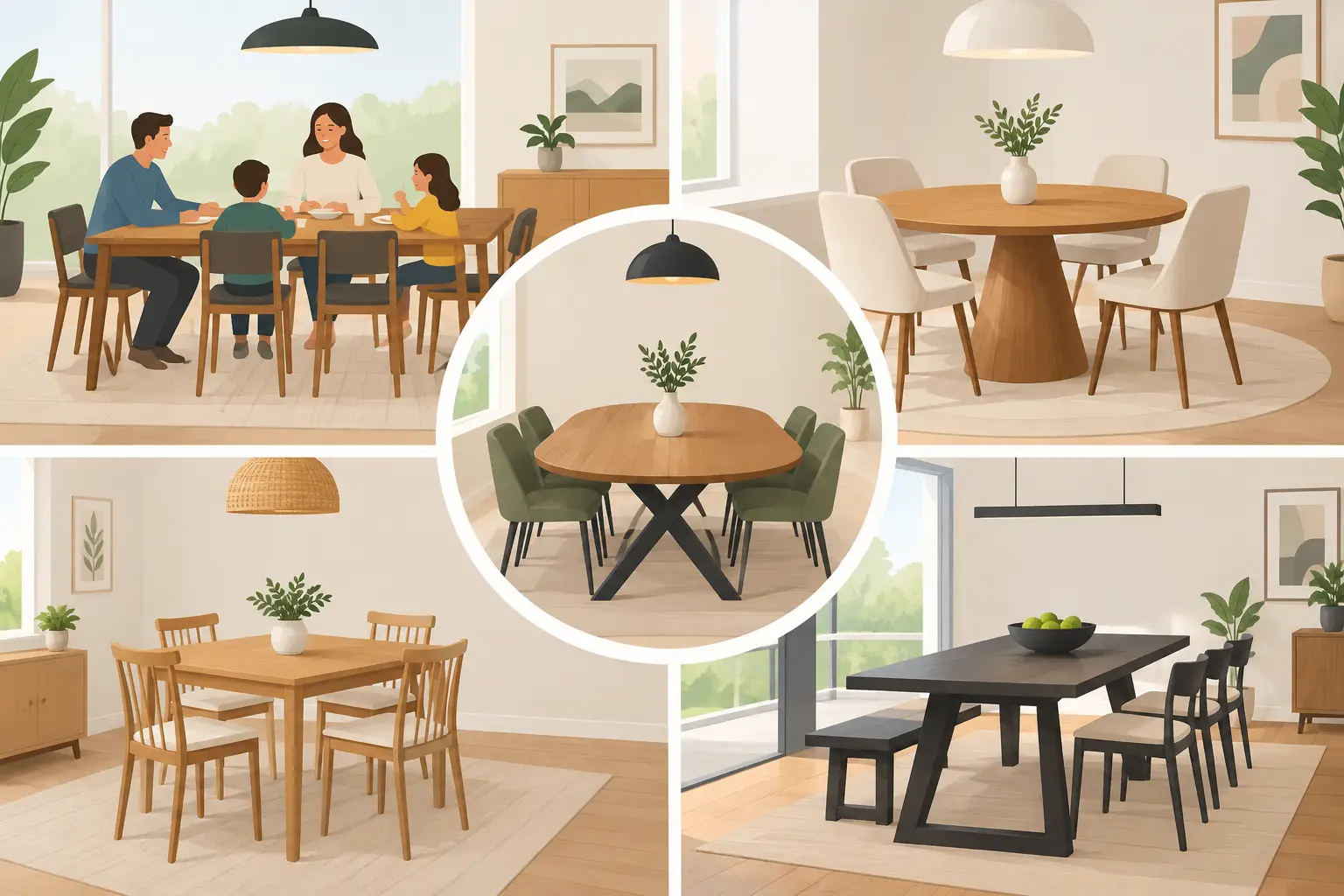
A dining table can be beautifully made, finished in the right wood tone, and still feel wrong if its shape fights the room. The best dining table shapes are not about following a trend. They are about how people move through your home, where chairs need to slide back, and whether the table makes everyday meals feel easy instead of cramped.
For a handcrafted solid wood table, shape deserves just as much attention as species, finish, and base style. A well-chosen shape makes a room feel more useful and inviting for years. Here is how to choose one that fits the way your family actually lives.
Start With the Room, Not the Seating Count
Most homeowners begin by asking how many people they need to seat. That matters, but the room’s usable footprint should come first. A table is only comfortable when there is enough clearance around it for chairs and people to pass.
As a practical rule, leave about 36 inches between the table edge and a wall, cabinet, or other furniture. A tighter 30-inch clearance can work in a compact room with limited traffic, but it will feel close when chairs are pulled out. If the dining area also serves as a path to the kitchen, patio, or living room, more breathing room is worth protecting.
Measure the space at its narrowest points, then use painter’s tape or cardboard to mark the table shape on the floor. This simple step often makes the right choice obvious. It shows where chair corners land, whether a walkway disappears, and how a shape changes the feel of the room.
The Best Dining Table Shapes by Room Layout
Rectangular tables: the reliable choice for long rooms
A rectangular dining table is the classic answer for a reason. It follows the lines of most dining rooms, works well in open-concept homes, and seats larger groups without requiring an oversized width. For a long, narrow room, it usually uses space better than any other shape.
Rectangular tables also offer the most flexibility for hosting. You can add leaves, seat guests at the ends, or choose a longer custom size for a large family. A table around 72 inches long can generally seat six comfortably, while an 84- to 96-inch table often suits eight, depending on chair width and table base.
The trade-off is corner clearance. Sharp corners can crowd a tight aisle and are easy to bump into in busy homes. If your dining area is narrow, keep the tabletop width modest or consider an oval shape with a similar seating capacity.
For custom wood tables, rectangular tops are especially versatile. They can be built with clean square edges for a tailored look, softened with eased corners, or given a more substantial profile that highlights the character of the wood grain.
Round tables: best for conversation and compact spaces
Round tables make people feel closer together. Everyone faces toward the center, no one gets stuck at the end, and passing food feels natural. They are an excellent fit for breakfast nooks, square dining rooms, and smaller spaces where a rectangular corner would interrupt traffic flow.
A 48-inch round table commonly seats four, while a 60-inch round table can seat six. The larger the diameter, however, the harder it becomes to reach dishes in the center. Once a round table gets much beyond 60 inches, a lazy Susan or a carefully planned centerpiece can make daily use more practical.
Round is one of the best dining table shapes for households that regularly share meals, play games, or gather with friends in a relaxed setting. The missing corners create a softer visual footprint and make it easier to move around the table.
Base design matters here. A pedestal base gives diners more legroom and makes it easier to add an occasional extra chair. Four legs can work, but they need to be positioned carefully so they do not compete with where people sit.
Oval tables: the soft-sided alternative for narrow rooms
An oval dining table gives you much of the seating capacity of a rectangle with gentler circulation around the ends. It is a smart choice for long rooms that feel too tight for squared-off corners, especially when the table sits near a walkway or kitchen island.
The curved ends also bring a more relaxed look to solid wood furniture. An oval top can soften a room full of straight cabinet lines, windows, and trim without losing the grounded feel of a substantial hardwood table.
Oval tables work particularly well for six to eight people. They can feel less formal than a rectangle, but they still provide enough length for serving dishes and family-style meals. Keep in mind that the curved ends offer less usable tabletop area than a rectangle of the same overall dimensions. If you often spread out homework, craft projects, or large platters, that difference may matter.
Square tables: best for square rooms and smaller groups
A square table feels balanced in a square room. It gives each person equal distance from the center and creates a comfortable setup for four people. In the right space, it can feel more intentional than a rectangular table that leaves too much empty room at either end.
The limitation is scale. A small square table is inviting, but a large one can become awkward fast. A 60-inch square table may seat eight, yet people across from one another can be far apart and center dishes can be difficult to reach. It also demands a generous square footprint, including clearance for chairs on all four sides.
Choose square when your dining area is genuinely square, your usual group is four, and you want an intimate, symmetrical layout. For larger gatherings, a rectangular or round table is often more comfortable.
Consider How You Use the Table Between Meals
The right shape is not only about dinner parties. Many tables become homework stations, laptop desks, project surfaces, and the landing place for grocery bags at the end of the day.
A rectangular tabletop provides the most uninterrupted work surface. It is often the strongest choice for a household that uses the table for more than meals. Round tables encourage connection, but their center-oriented layout can feel less efficient for spreading out papers or working side by side.
If children are part of the picture, rounded edges are worth considering. An oval or round top eliminates sharp corners, while a rectangular table with gently eased corners preserves useful surface area with a little more forgiveness in a busy room.
Also think about chairs, benches, and table bases together. Benches pair naturally with rectangular tables and can tuck neatly underneath when not in use. Pedestal bases favor round and oval shapes because they keep legs out of the seating zone. A trestle base can bring excellent support to a long wood table while leaving the ends open for chairs.
Match the Shape to Your Style Without Letting Style Lead
Shape has a real visual effect, but function should make the final call. Rectangular tables suit farmhouse, traditional, modern, and transitional homes because their clean geometry is easy to tailor through wood species, edge detail, and base design. A thick butcher block-style top can feel warm and substantial, while a slimmer profile leans more contemporary.
Round and oval tables are especially at home in softer, more organic interiors. They work well when you want a room to feel welcoming rather than formal. Square tables have a clean, structured appearance that can look striking in modern or craftsman-inspired spaces.
Solid wood makes every shape feel more personal. Grain direction, natural color variation, and hand-finished details turn a dining table into a working piece of furniture with real presence. That is why custom sizing is so valuable: the best proportions for your room may fall between standard retail dimensions.
When Custom Sizing Makes the Difference
Standard dining tables are built around broad averages. Your room probably is not. A radiator, bay window, island overhang, doorway, or built-in bench can change the dimensions that make sense.
A made-to-order table lets you adjust the length, width, corner treatment, top thickness, and base placement around your actual home. Sometimes an extra four inches of length makes room for another guest. Other times, reducing the width by two inches preserves the walkway that keeps the whole space comfortable.
Tooill Cabinets approaches custom woodwork with that real-home perspective. A dining table should not force you to rearrange your life around it. It should fit your room, hold up to daily use, and still look better as it becomes part of your family’s story.
Before choosing, mark the footprint, pull out a few chairs, and picture an ordinary Tuesday night as clearly as a holiday meal. The shape that gives people room to gather, move, and stay awhile is the one you will be glad to live with.