
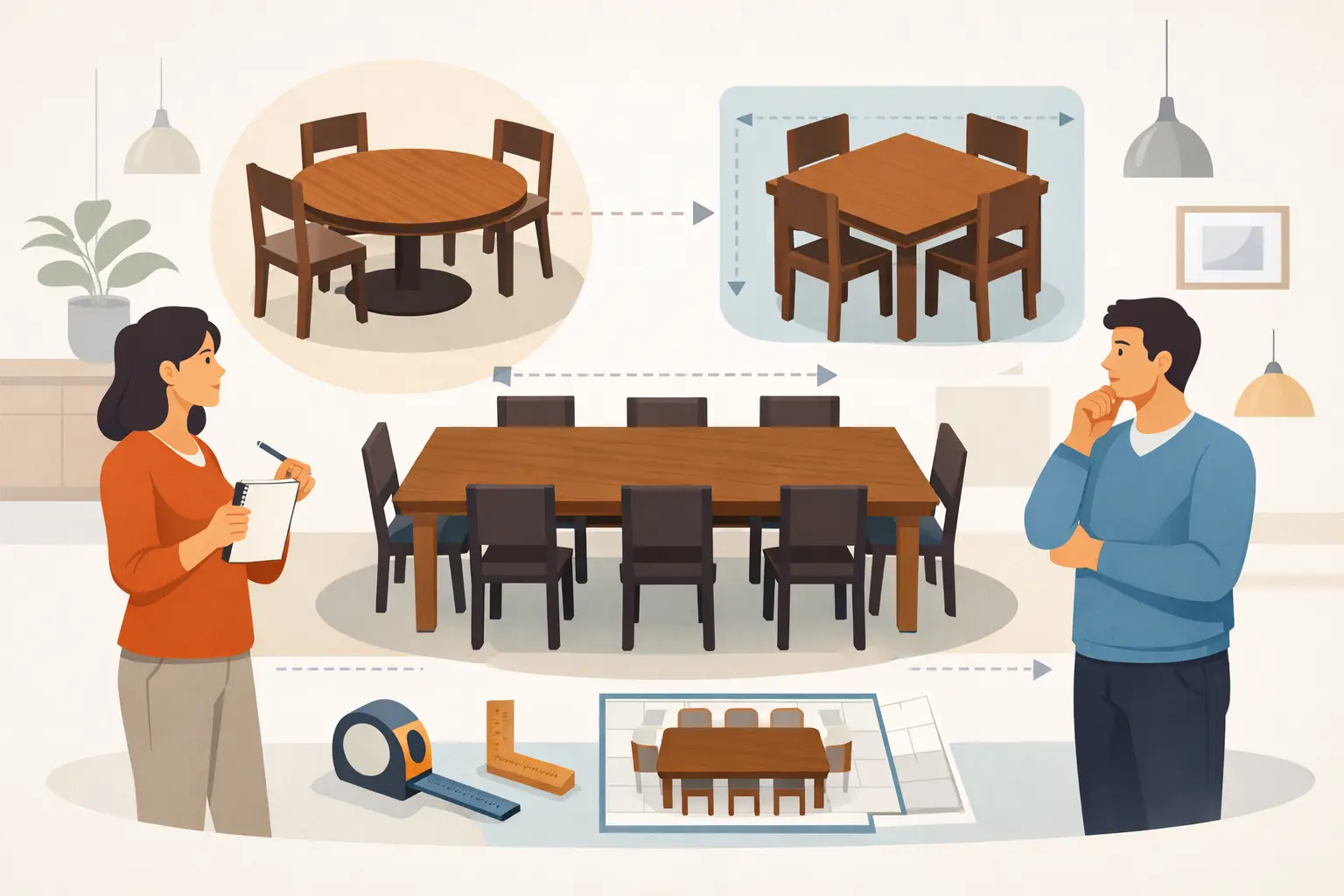
A dining table can look perfect in a photo and still feel completely wrong once it lands in your home. Too small, and every dinner feels cramped. Too big, and the room starts working against you. If you are wondering how to pick dining table size, the right answer starts with your space, but it should end with how you actually live.
That matters because dining tables are not just measured by length and width. They are measured by chair movement, traffic flow, elbow room, and whether the table still feels good on an ordinary Tuesday night when nobody is entertaining. A good fit is about comfort as much as dimensions.
How to Pick Dining Table Size for Your Room
The first measurement is not the table. It is the open space around it. In most homes, you want about 36 inches of clearance from the edge of the table to the wall or any other large obstacle. That gives enough room to pull a chair out and move around the table without turning every meal into a shuffle.
If the dining area is a tighter pass-through space, 36 inches is still a workable minimum, but 42 to 48 inches feels better when people regularly walk behind seated guests. That extra room makes a big difference in a kitchen-dining layout where traffic never fully stops.
A simple way to calculate your target table size is to measure the room, then subtract 72 inches from both the length and width. That accounts for 36 inches of clearance on each side. For example, if your room is 12 feet by 14 feet, or 144 by 168 inches, a table footprint around 72 by 96 inches is usually the upper comfortable range. You do not have to go that large, but going past it often creates problems.
This is where standard retail sizing can fall short. Real homes rarely fit standard dimensions perfectly. If your room needs something between common sizes, custom sizing can save you from buying a table that is close enough but never quite right.
Start With Seating, Not Just Floor Plan
Most people shop by room size first, then think about seats. In practice, both need to work together. A table that technically fits the room can still be wrong if it does not handle your daily seat count.
As a rule of thumb, allow about 24 inches of table edge per person for comfortable seating. You can squeeze down to 20 or 22 inches in a pinch, but that is better for occasional gatherings than everyday use. If you want guests to relax, 24 inches is the safer number.
Here is what that means in real terms. A 60-inch rectangular table usually seats 6 if two people sit on each long side and one at each end. A 72-inch table gives those same 6 people more breathing room, or it can handle 8 for holidays and larger meals. An 84-inch table is often a sweet spot for families who host regularly because it seats 8 comfortably without pushing into oversized territory in many homes.
Round tables work a little differently because there are no corners. A 48-inch round table typically seats 4 well. A 60-inch round table usually seats 6. Once you go larger than that, round tables can become harder to reach across, so the room and the intended use matter more.
Common dining table sizes by seat count
A table for 4 often falls around 36 to 48 inches round, or about 48 inches long if rectangular. For 6, think roughly 60 to 72 inches long or around 60 inches round. For 8, 72 to 96 inches long is common depending on width and whether people sit at the ends. For 10, you are usually looking at 96 inches and up.
These are not hard rules. Chair width, table legs, pedestal bases, and apron design all affect usable seating.
Shape Changes the Way a Table Fits
If you are deciding how to pick dining table size, shape matters almost as much as size. A rectangular table is the most common choice because it uses space efficiently and works well in long rooms. It is usually the easiest option for seating more people without overwhelming the space.
Round tables feel more conversational and soften a room with lots of straight lines, but they need enough surrounding space to breathe. In a square room, a round table often looks more balanced than a rectangle. In a narrow room, it can waste valuable floor area.
Oval tables land somewhere in the middle. They give you the softer visual feel of a round table but use length more efficiently. They can be a smart choice when you want better traffic flow around corners.
Square tables are best in square rooms and for smaller groups. Once they get too large, people across from each other can feel far apart, and the center can become awkward to reach.
The right shape depends on the room layout, but also on the feeling you want. A rectangular table tends to read more traditional and practical. A round or oval table often feels more relaxed and social.
Table Width Is Easy to Overlook
Length gets most of the attention, but width has a major impact on comfort. A dining table around 36 to 42 inches wide is a strong range for most homes. That is wide enough for place settings and serving dishes without making conversation feel distant.
Go much narrower, and the table can feel skimpy, especially in solid wood. Go much wider, and everyday meals may feel less connected unless the table is quite long and the room can support it.
For larger custom tables, width should match both the visual scale of the room and the practical use of the table. If the table is mainly for family meals, a moderate width often works best. If it doubles as a statement piece for entertaining, a wider top may make sense.
Don’t Forget Chair and Base Clearance
This is where a lot of sizing mistakes happen. Two tables with the same outside dimensions can seat very differently depending on the base.
A pedestal base usually gives more flexible seating because there are no corner legs to work around. That can make a round table more comfortable for an extra guest. Trestle bases can also help, especially on long farmhouse-style tables, but placement matters. If the supports sit too close to the ends, legroom suffers.
With four-legged tables, think about where those legs land in relation to chairs. If you are trying to maximize seating on a smaller footprint, a table with better knee clearance can matter more than an extra few inches of length.
Chair size matters too. Upholstered armchairs take up more room than slim side chairs. If you love the look of substantial dining chairs, build that into your measurement plan from the beginning.
Plan for Daily Life, Not Just Big Gatherings
A lot of buyers choose a table for Thanksgiving and then live with it the other 364 days of the year. That usually leads to buying too large.
It is better to size for everyday comfort first, then think about occasional guests second. If you host often, extensions or leaves can be the better answer. If you host rarely, it may make more sense to keep the table proportionate to your room and bring in extra seating only when needed.
This is one of those it-depends decisions. A family of five that uses the dining table for homework, projects, and daily meals may genuinely need more surface area than a couple who mostly eats in the kitchen and hosts once a month. The right size is not just about the room. It is about the role the table plays in the home.
Why Custom Sizing Can Be Worth It
When you are working with solid wood furniture, small dimension changes can have a big payoff. An extra 6 inches in length may be the difference between comfortably seating 6 and constantly feeling crowded. Trimming a table width by a few inches can open up the whole room.
That is why custom sizing makes sense for so many homeowners. You are not forced into standard dimensions that almost fit. You can match the table to your exact layout, your chair style, and your seat count. For handcrafted tables, that kind of fit usually feels better long after the purchase than simply choosing the nearest ready-made option.
At Tooill Cabinets, that is often the advantage customers are after – a table built to the dimensions their home actually needs, not the dimensions a warehouse happens to stock.
A Quick Way to Check Before You Buy
Tape the table dimensions out on your floor. Then place chairs, or even empty boxes, where seats would go. Walk around it. Pull the chairs out. Pretend somebody is carrying plates through the room while someone else is seated.
It sounds simple because it is. And it is one of the best ways to catch a sizing problem before wood is cut or a delivery is scheduled.
A dining table should feel settled in the room, not forced into it. When the size is right, the whole space gets easier to use, and the table stops being just another piece of furniture. It becomes the place people naturally gather.