
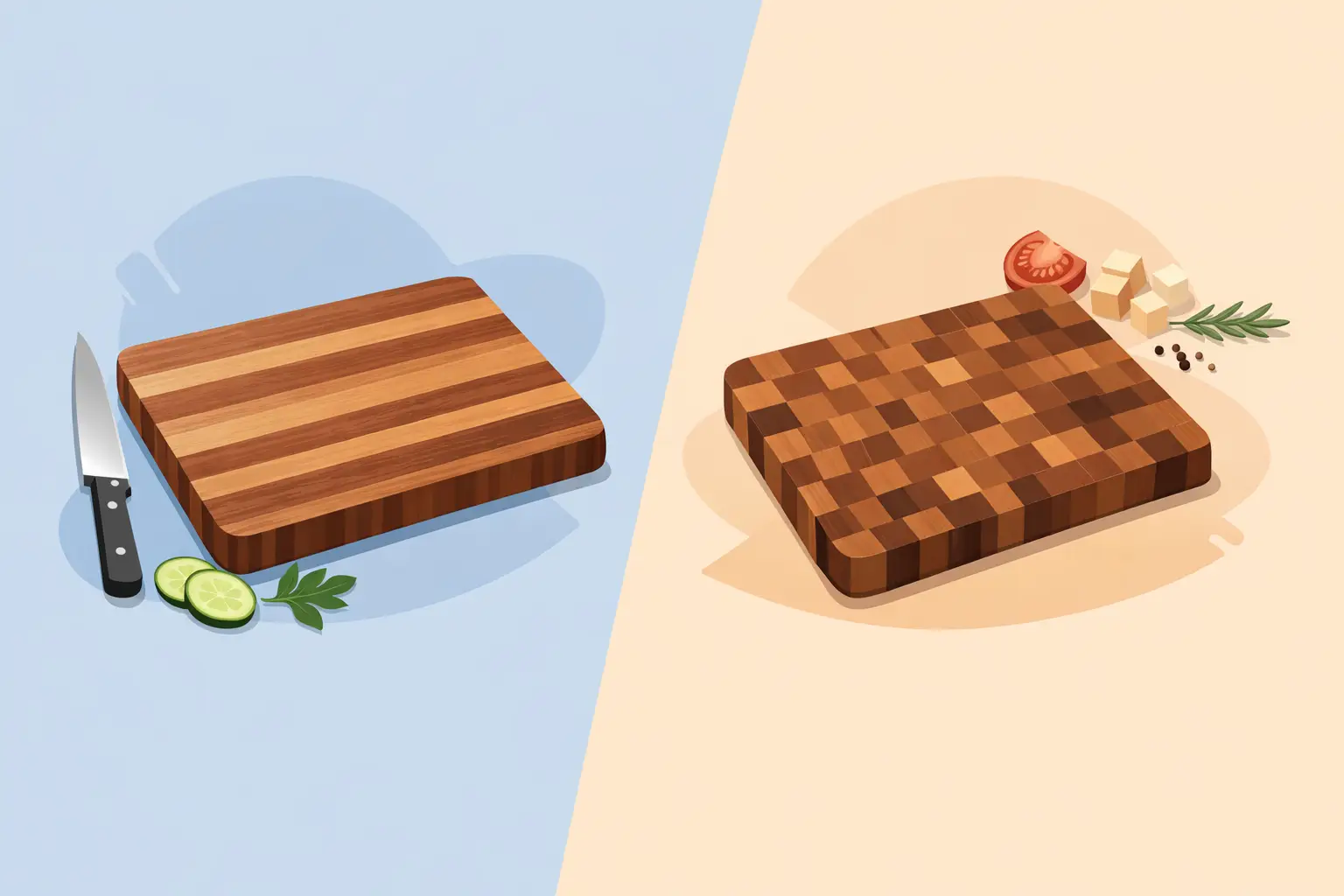
If you have ever held two solid wood boards side by side and wondered why one costs noticeably more, the answer usually comes down to construction. In the edge grain vs end grain cutting board debate, the best choice is not about hype. It is about how you cook, how much maintenance you want, and what kind of look and feel you want on your counter.
For some kitchens, an edge grain board is the smarter buy. For others, end grain earns its price. When you understand how each one is built, the differences make a lot more sense.
Edge grain vs end grain cutting board: what is the difference?
An edge grain cutting board is made by gluing long strips of wood together with the narrow edge facing up. That creates a surface with long, consistent grain lines. It is a classic look, and it is one of the most common constructions for high-quality wood cutting boards and butcher block style tops.
An end grain cutting board is built differently. The wood is cut into blocks and turned so the ends of the fibers face up. Instead of long lines, you see a checkerboard or brick-like pattern across the surface. This construction takes more labor, more material planning, and more precision to build well.
That visual difference is only part of the story. The bigger question is how the board behaves when you actually use it.
How each board feels under the knife
End grain is often called the premium option because it is gentler on knife edges. When a blade comes down on an end grain surface, the wood fibers separate slightly and then close back up. That means the knife is not slamming across long fibers in the same way it does on a flatter grain orientation.
In practical terms, end grain tends to feel a little softer and more forgiving during heavy prep. If you do a lot of chopping, especially with quality kitchen knives, that matters.
Edge grain is still a solid performer. It is durable, dependable, and far better for your knives than glass, stone, or other harsh surfaces. But compared with end grain, it usually shows cut marks a bit faster and does not have the same self-healing character.
That said, not every home cook needs the most knife-friendly board possible. If your board gets regular use but not constant professional-level prep, edge grain can be a very sensible middle ground.
Durability is not the same as hardness
A lot of buyers assume the harder board is automatically the better board. That is not always true.
Edge grain boards are often prized for their structural stability and straightforward strength. They can handle daily use well, and they hold up nicely when built from quality hardwoods like maple, walnut, or cherry. Because the grain runs lengthwise across the surface, edge grain boards often have a clean, uniform appearance that works well in both modern and traditional kitchens.
End grain boards are also highly durable, but in a different way. They are better at absorbing repetitive chopping impact. This makes them especially popular for serious cooks, butchers, and anyone who wants that thick, substantial board that stays planted during prep.
Construction quality matters more than labels alone. A well-made edge grain board will outlast a poorly made end grain board every time. Proper wood selection, strong glue joints, careful milling, and a food-safe finish all play a bigger role than many shoppers realize.
Which one is easier to maintain?
Both board types need regular care. Solid wood is a natural material, and it performs best when it is cleaned correctly and oiled when needed.
Edge grain boards are often a little simpler for everyday owners. They tend to be lighter than thick end grain boards, so they are easier to carry to the sink, wipe down, and move around the kitchen. If you want a board that works hard without feeling bulky, edge grain has an advantage there.
End grain boards usually need the same basic maintenance, but they are often heavier and thicker, which can make handling them less convenient. They also represent a larger upfront investment, so owners tend to be more careful about conditioning and storage. That is not a downside if you like caring for quality wood products. It just means end grain is often a more committed purchase.
Neither type should be left soaking in water or put in a dishwasher. Both should be dried promptly and maintained with a food-safe board oil or conditioner. If you do that consistently, either one can serve for years.
Appearance matters more than people admit
A cutting board is a working tool, but in many kitchens it also lives out in the open. It sits on the counter, leans against a backsplash, or gets used as a serving piece when guests are over. So looks count.
Edge grain boards have a clean, linear appearance. They often read as understated, timeless, and versatile. If you like the look of butcher block countertops or long wood grain patterns, edge grain usually fits naturally into that style.
End grain boards have more visual texture. The block pattern gives them a handcrafted, substantial presence that many buyers love. They tend to look more custom and more specialized, especially in thicker formats.
This is one of those places where personal preference should lead the decision. Some people want the polished simplicity of edge grain. Others want a board that feels like a centerpiece. Neither is wrong.
Price differences in the edge grain vs end grain cutting board choice
End grain boards almost always cost more, and there is a real reason for that. They take more labor to build, more cutting and reassembly, and more attention during glue-up and surfacing. Waste can also be higher depending on the design and wood species.
Edge grain boards are generally more budget-friendly while still offering the warmth, performance, and longevity people want from solid hardwood. For many homeowners, that makes edge grain the better value.
The question is whether the added benefits of end grain match your actual use. If you cook every day, use sharp chef’s knives, and want a board that can handle years of serious prep while looking impressive on the counter, end grain may be worth every dollar. If you want a premium handmade board for daily slicing, serving, and general kitchen work, edge grain may be the smarter purchase.
When edge grain is the better fit
Edge grain makes a lot of sense for buyers who want a dependable work surface without stepping into the higher price range of end grain. It is also a strong option when custom sizing matters, since it can be built in a wide range of dimensions for different kitchens and uses.
If you need a board for everyday meal prep, sandwich making, fruit, vegetables, and general utility, edge grain checks a lot of boxes. It is attractive, durable, easier to handle, and often easier on the budget.
It is also a great choice if you want a piece that visually connects with other wood features in the home, such as shelves, island tops, or butcher block counters.
When end grain is worth it
End grain stands out when performance is the priority. If you spend a lot of time chopping, breaking down proteins, or working with high-end knives, the extra investment can make sense. The surface is kinder to blades, and many users appreciate the heavier, more anchored feel.
It also suits buyers who want that unmistakable handcrafted look. A thick end grain board has presence. It feels substantial because it is substantial.
For gift buyers, end grain often lands as the more dramatic option. It has a premium feel that reads immediately, especially in kitchens where the board will stay on display.
Custom sizing can matter as much as construction
A board can be beautifully made and still be wrong for your kitchen if the size does not fit the way you actually work. That is one reason handmade wood products stand apart from mass-produced options. Dimensions, thickness, wood species, juice grooves, feet, handles, and finish details all affect how useful the board feels day to day.
A smaller edge grain board may be perfect for apartment living or a secondary prep station. A large end grain board may be ideal for a serious home cook who wants a dedicated centerpiece on the island. The right answer depends on your space, your habits, and what you want the board to do when it is not in use.
That practical custom mindset is where a maker-focused shop like Tooill Cabinets can really help. Good craftsmanship is only part of the value. Building to the way a customer actually uses their kitchen is the other part.
So which should you buy?
If you want the short answer, buy edge grain if you want strong value, clean looks, easier handling, and excellent everyday performance. Buy end grain if you want the most knife-friendly surface, a heavier premium feel, and a board built for frequent chopping.
Neither one is automatically better for everyone. The right board is the one that matches your kitchen, your habits, and your expectations for maintenance and lifespan.
A good wood cutting board should feel like something you will still be glad you bought years from now. Pick the construction that fits the way you cook, and you will notice the difference every time you set the knife down.