
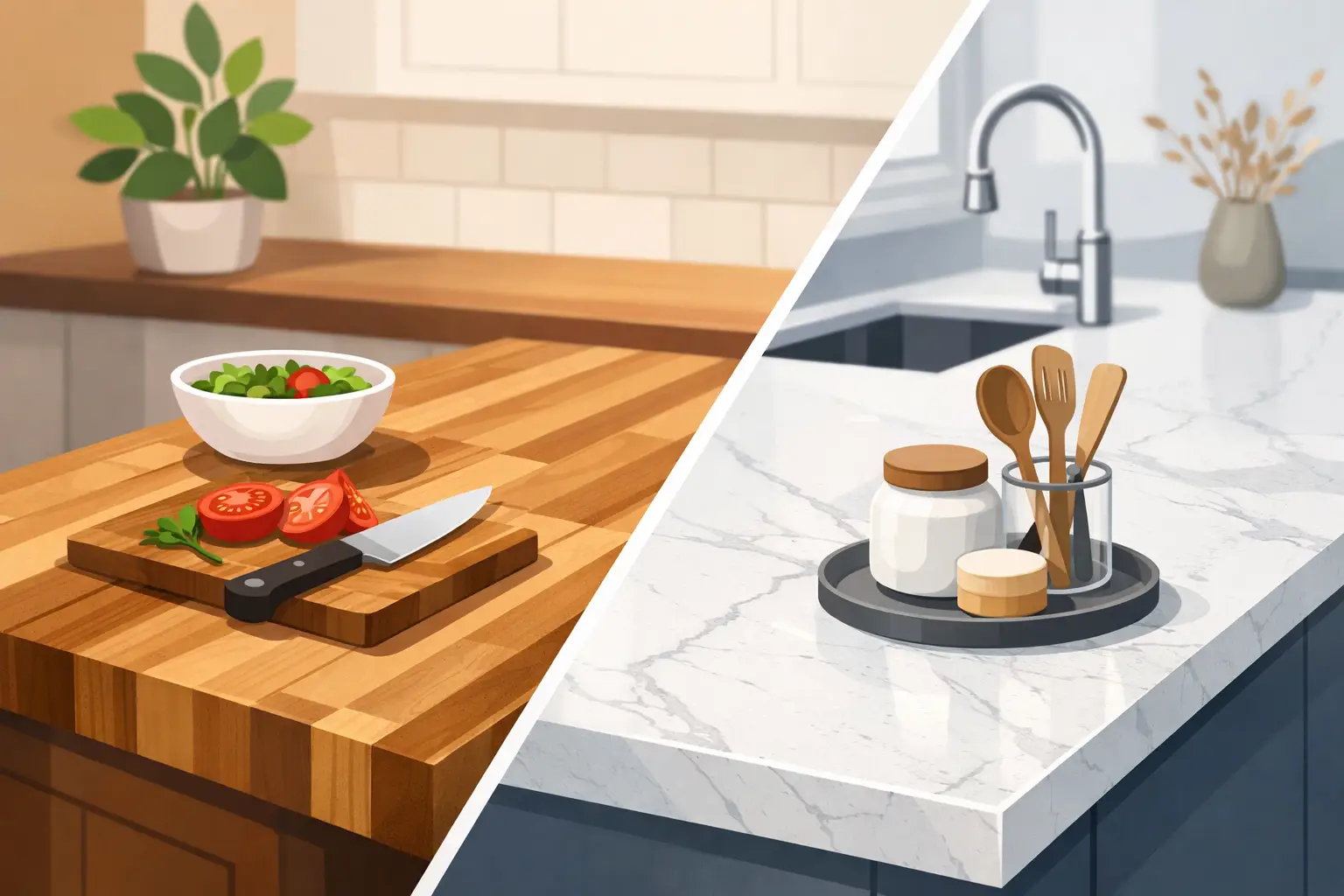
If you’re stuck on butcher block vs quartz countertops, you’re probably not choosing between a good option and a bad one. You’re choosing between two very different ways a kitchen lives and feels day to day. One brings warmth, character, and a hand-built look. The other offers a low-maintenance, polished surface that stays consistent with very little effort.
That difference matters more than the showroom sample suggests. Countertops are one of the hardest-working surfaces in the house, and the right pick depends on how you cook, how much upkeep you want, and whether you want your kitchen to feel natural and lived-in or crisp and uniform.
Butcher block vs quartz countertops at a glance
Butcher block is a real wood surface, usually built from strips of hardwood glued into a solid slab. It has visible grain, natural variation, and a warmth that man-made materials simply don’t copy very well. It can be custom-sized easily, repaired over time, and refinished when life leaves marks.
Quartz is an engineered stone product made from ground quartz and resins. It gives you a more controlled look, strong stain resistance, and less routine maintenance than wood. It also tends to feel more fixed – once damaged, it is usually not something you sand out and refresh.
Neither material is automatically better. The better choice depends on what you value most.
What butcher block does better
The biggest reason people choose butcher block is simple: it feels real. The grain, tone shifts, and texture give a kitchen a lived-in quality that works especially well in farmhouses, transitional spaces, warm modern kitchens, and homes where the goal is comfort as much as style.
It is also one of the most forgiving countertop materials when it comes to customization. If you need an unusual island size, a narrow run, a thick statement top, or a made-to-order piece for a laundry room, pantry, coffee bar, or workbench area, wood is often easier to build to exact dimensions than slab stone alternatives.
There is also the repair factor. Wood gets marks. That is true. But wood can also recover. Small scratches, light wear, and even more noticeable surface issues can often be sanded and refinished instead of forcing a full replacement. For homeowners who want something they can maintain and keep for years, that matters.
Price can also work in butcher block’s favor, depending on the species, thickness, and size. High-end custom hardwood tops are not bargain materials, but they can still come in below premium quartz installations, especially when the project calls for custom sizing and a handcrafted look.
Where quartz has the advantage
Quartz wins a lot of people over because it asks less of you. It does not need oiling. It does not need periodic refinishing. It handles everyday messes well, and for busy households that want a surface to wipe down and move on, that convenience is real.
It is also more resistant to staining from common kitchen spills when properly used and maintained. Coffee, wine, sauces, and oils are less stressful on quartz than on unfinished or poorly maintained wood. If your kitchen sees heavy traffic, rushed mornings, and lots of quick cleanup, quartz can fit that routine better.
Quartz also gives a more uniform appearance. If you want clean pattern control, consistent color, and a sleek design direction, it is often the easier choice. Some homeowners love that predictability. Others find it a little colder than natural materials. That part is personal.
Cost: the answer is usually it depends
A lot of shoppers ask which is cheaper, but butcher block vs quartz countertops is not a one-number comparison. Material grade, installation, edge profile, cutouts, thickness, shipping, and custom dimensions all affect the final cost.
Entry-level butcher block can cost less than quartz, but not all butcher block is the same. A handcrafted hardwood top made in the USA with custom sizing and quality finishing is a different product than an off-the-shelf panel from a big-box store. Likewise, quartz spans a wide price range, and installation costs can climb once you add sink cutouts, seam planning, and labor.
If you are comparing honestly, compare like for like. A custom wood top built to your exact dimensions should be weighed against a professionally fabricated quartz surface, not the cheapest version of either category.
Maintenance and daily care
This is where many decisions get made.
Butcher block needs regular care, but not constant attention. If it is finished properly and maintained as recommended, it holds up well in real kitchens. Oiled finishes need reapplication over time. More protective finishes reduce maintenance, though they also change how the surface behaves and is used. Homeowners who appreciate natural materials usually do not mind this trade-off because the upkeep is straightforward and the reward is a surface that ages with character.
Quartz is easier on the maintenance side. You wipe it down, avoid abuse, and it generally stays looking the same with less effort. That said, low maintenance does not mean indestructible. Quartz can chip on edges, and excessive heat can be a problem because of the resin content.
If you want the least hands-on option, quartz usually wins. If you are comfortable caring for a natural material and like the idea of renewing it over time, butcher block remains a strong choice.
Durability is not just about hardness
People often assume harder means better, but countertop durability is more nuanced than that.
Quartz is harder and generally more resistant to scratching in normal use. It performs well against everyday wear, and that is a real strength. But when quartz does chip or crack, repairs can be limited and sometimes visible.
Butcher block is softer, so it will show use sooner. You may see dents, knife marks, or wear patterns depending on how the surface is used. But unlike quartz, wood is repairable in a very practical way. You can sand, refinish, and restore it. For some homeowners, that makes wood more durable over the long haul because it can be renewed instead of replaced.
So the real question is not which surface never changes. It is which kind of aging you are more comfortable living with.
Style and how the room feels
In the butcher block vs quartz countertops debate, style is not just visual. It is emotional.
Butcher block softens a room. It adds warmth to painted cabinets, contrast to white kitchens, and texture to spaces that feel flat with too many hard surfaces. It works especially well on islands, accent areas, bar tops, and spots where you want furniture-like character instead of a fully engineered feel.
Quartz creates a cleaner, more controlled look. It suits modern kitchens, busy family spaces, and designs where consistency matters. It can brighten a room and pair well with bold cabinetry or minimalist finishes.
Many well-designed kitchens use both approaches in some form. Quartz on the perimeter and butcher block on the island is a common example because it gives you easy cleanup where spills happen most and natural warmth where people gather.
When butcher block makes the most sense
Butcher block is a strong fit if you want custom sizing, value real wood craftsmanship, and like a kitchen that feels warm rather than clinical. It also makes sense if you are comfortable with basic maintenance and want a surface that can be repaired and refinished instead of discarded.
It is especially appealing for islands, prep areas, bars, laundry counters, pantry worktops, and statement surfaces where wood can bring the whole room together. For homeowners who care about made-to-order details, this is where a custom shop can make a big difference.
When quartz is probably the better fit
Quartz is likely the better choice if your top priority is minimal upkeep, strong stain resistance, and a uniform appearance. It also fits households that want a set-it-and-forget-it surface and do not want to think about re-oiling or refinishing later.
If your kitchen gets hard daily use and convenience outranks natural character, quartz often makes that easier.
The better question to ask
Instead of asking which material is best, ask which one fits the way you actually live. If you love natural materials, want flexibility in sizing, and appreciate the fact that real wood can be maintained for years, butcher block offers something quartz cannot. If you want consistency, simple cleanup, and less ongoing care, quartz has a clear edge.
At Tooill Cabinets, we know wood is not for everyone. But for homeowners who want a countertop with warmth, craftsmanship, and custom dimensions built around the room instead of forcing the room to fit the product, butcher block is hard to beat.
The right countertop should make your kitchen easier to use and better to come home to – and that usually starts by being honest about whether you want perfection that stays still, or character that gets better with time.