
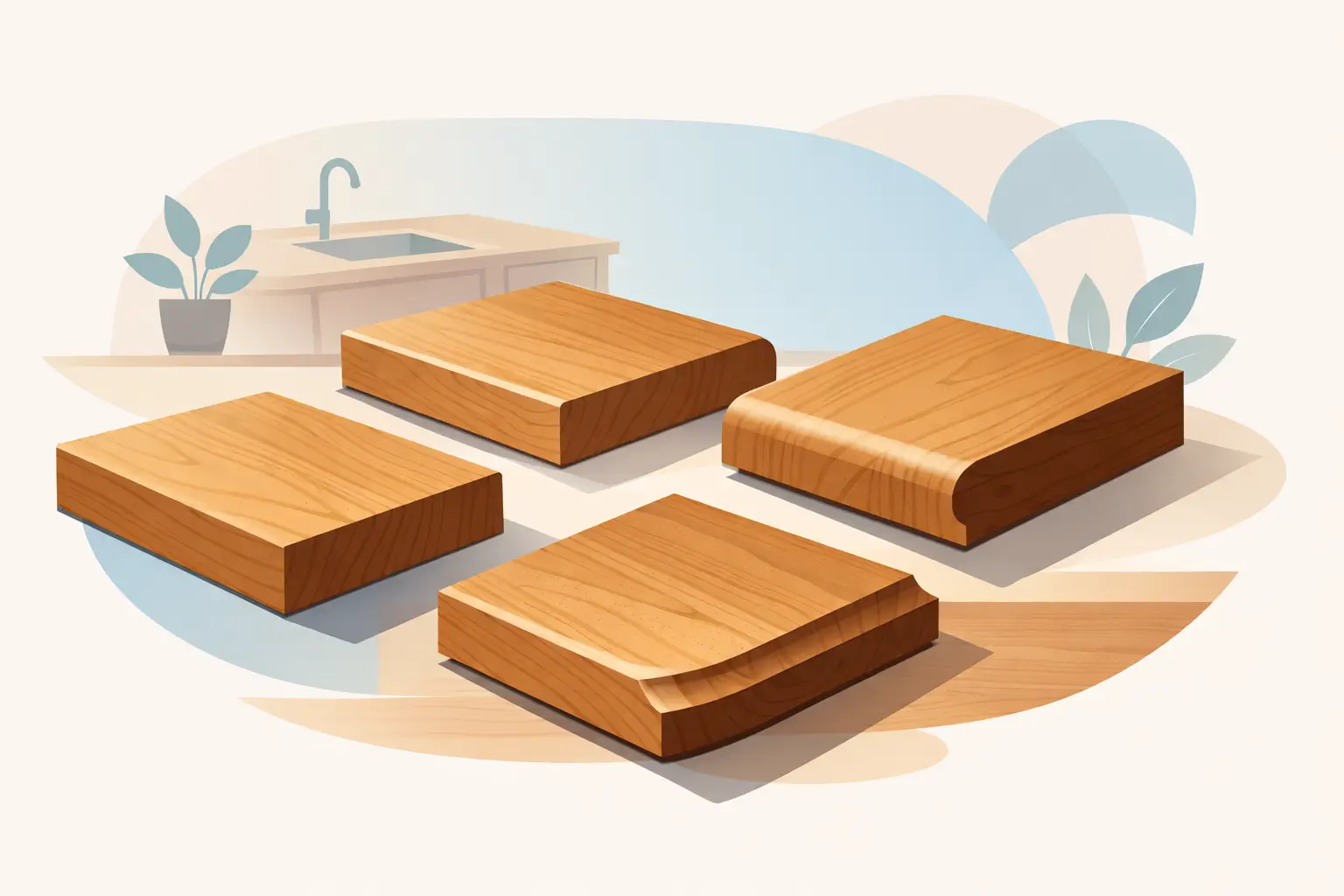
A countertop edge is a small detail with a big job. It is where hands rest, hips brush past an island, and chairs get pulled in close to a dining table. The right custom countertop edge options can make a handcrafted wood top feel clean and modern, relaxed and traditional, or built for serious everyday kitchen use.
For a custom butcher block countertop, the edge profile should work with the wood species, top thickness, room style, and how the surface will be used. A dramatic profile may be right for a furniture-style island, while a simple softened edge is often the better choice for a hardworking prep area. There is no one best edge, but there is a best fit for your home.
Start With How the Countertop Will Be Used
Before choosing a profile by appearance alone, think about where the top will live. A kitchen island that doubles as a breakfast bar gets constant contact. People lean on it, children do homework there, and stools slide underneath it. A softer edge is comfortable in that setting and less likely to feel sharp when someone bumps into it.
A laundry-room folding counter, desk surface, or pantry shelf may call for a quieter detail. In those spaces, a lightly eased edge keeps the look tidy without drawing attention away from the wood grain. A dining table or furniture-style island can support more visual character because the edge becomes part of the overall design.
Thickness matters, too. A 1 1/2-inch or 1 3/4-inch thick butcher block has enough material for a fuller roundover, bullnose, or ogee. On a thinner wood top, an elaborate profile can take away too much visual weight or leave a narrow flat area at the top. Good fabrication starts with matching the profile to the material, not forcing a decorative shape onto every slab.
The Most Popular Custom Countertop Edge Options
Eased Edge: Simple, Clean, and Easy to Live With
An eased edge is not perfectly sharp. The corner is lightly softened with a small radius or hand-sanded break, while the overall top still reads as square. It is one of the most versatile choices for butcher block countertops, floating shelves, desktops, and modern dining surfaces.
This profile lets the wood do the talking. It preserves a crisp, substantial look without leaving an uncomfortable or fragile sharp corner. It also fits well with shaker cabinetry, modern kitchens, farmhouse spaces, and nearly any design that favors straightforward workmanship over ornament.
For many homeowners, an eased edge is the practical default. It is easy to wipe clean, easy to refinish later if needed, and less prone to noticeable dings than a knife-sharp square corner.
Roundover: A Softer Everyday Edge
A roundover creates a more obvious curve along the top edge. The radius can be modest for a subtle softened look or larger for a more relaxed, substantial feel. A small roundover is often chosen for kitchen counters and cutting surfaces, while a larger radius works nicely on a bar overhang, family island, or table where comfort matters most.
Roundovers are especially forgiving in busy homes. They remove the hard edge that catches clothing or feels uncomfortable against an arm. They also complement the natural warmth of maple, walnut, cherry, white oak, and other solid woods.
The trade-off is visual. A large roundover can make a thick countertop appear slightly less crisp and more casual. If you want a sharp-lined contemporary kitchen, a small eased edge may better match that direction.
Beveled or Chamfered Edge: A Crisp Architectural Detail
A bevel, also called a chamfer, replaces the square corner with a flat angled cut. It brings more definition than an eased edge without becoming overly decorative. From a distance, it can make the countertop look slimmer and more tailored, especially on a thick wood island top.
This is a strong choice for homes with modern, industrial, transitional, or craftsman influences. A bevel catches light differently than a roundover, creating a clear line around the perimeter. It can also echo other angled details in a room, such as cabinet pulls, lighting, or a range hood.
Beveled edges need thoughtful finishing because the angled face is visible from standing height. On a handmade top, the grain and finish should carry cleanly across that detail. A very sharp bevel can still feel angular, so it is worth discussing how much the outer corner should be softened.
Bullnose: Full, Traditional, and Family-Friendly
A bullnose edge is rounded over more completely, often creating a soft curve from the top face down toward the side. It has a finished furniture quality and feels comfortable from every angle. Full bullnose profiles are common on tables, breakfast bars, and islands with seating.
Because the curve is more pronounced, a bullnose is best on thicker material. It looks intentional when there is enough depth in the countertop to show the profile properly. On a slim top, it can look overly rounded or reduce the clean flat reveal at the edge.
This profile suits traditional kitchens, rustic homes, and spaces where the wood top is meant to feel inviting rather than strictly minimal. It is also a sensible option around young children, though no countertop edge can make a hard wood surface completely impact-proof.
Ogee Edge: Decorative Without Losing the Wood’s Character
An ogee profile uses an S-shaped curve, typically combining a small concave section with a rounded lower portion. It adds formal detail and can make an island or table feel more like custom furniture than a standard work surface.
Ogee edges are best used with restraint. They pair naturally with detailed cabinetry, classic trim, and traditional interiors, but they can look out of place next to very plain slab-front cabinets or ultra-modern hardware. They also require more careful cleaning than a simple edge because the curves create small transitions where crumbs and dust can collect.
For a statement island, an ogee can be worth the added detail. For a cutting counter or utility top, a simpler profile is usually easier to maintain and more in keeping with the job at hand.
Keep the Wood Species and Grain in View
Edge selection is about more than shape. Different woods carry a profile differently. Walnut has rich contrast that can make a bevel or ogee stand out. Hard maple has a calm, even appearance that works beautifully with clean eased or roundover edges. White oak offers visible grain and texture that suits both simple modern profiles and warmer furniture-inspired details.
The construction of the top also affects the look. Face-grain butcher block shows long boards across the surface, so the edge can reveal the ends and sides of those boards. End-grain blocks have a different visual pattern and are generally used for dedicated cutting surfaces rather than full countertop installations. A well-made edge should feel like a natural continuation of the top, not an afterthought added after the fact.
Stain and finish can make the profile more or less noticeable. A natural finish often highlights subtle curves through shifting light. A darker stain may emphasize the edge line and create more contrast at the perimeter. Samples and photos are helpful, but it is smart to picture the top in the actual light of your room.
Choose for Comfort, Cleaning, and Future Care
Wood countertops are made to be used, and edge profiles should support that. Simple eased, small roundover, and modest bevel edges are the easiest to wipe down and the easiest to refresh if the surface ever needs sanding and re-oiling. They also tend to age gracefully because minor wear blends into the handmade character of the piece.
Deep decorative profiles take more labor to produce and more care to refinish. That does not make them a poor choice. It simply means the decision should be intentional. If the countertop is a centerpiece with limited food prep, a detailed edge may be exactly right. If it will see daily chopping, spills, school projects, and heavy use, uncomplicated usually wins.
Also consider what sits below the edge. An overhang for stools needs enough clearance to be comfortable, and a pronounced profile can slightly change how that front edge feels. If the top meets a wall, range, sink, or tall appliance, measurements should account for the finished edge rather than only the flat top dimensions.
Bring Your Edge Choice Into the Custom Order
The best time to choose an edge profile is while the countertop is being designed. Provide the finished length, width, thickness, wood preference, intended use, and any overhang measurements. A few photos of the room, cabinetry, or nearby furniture can also help establish whether a soft, crisp, or decorative edge will feel at home.
At Tooill Cabinets, handcrafted wood tops are built around the details that make a surface fit the space, not just fill it. An edge profile is one of those details. It affects the way the countertop looks from across the room and the way it feels every time you use it.
Choose the profile that suits the life your wood top will live. A clean eased edge may be the quiet right answer, while a generous roundover or classic ogee may be the detail that makes the entire piece feel made for your home.