
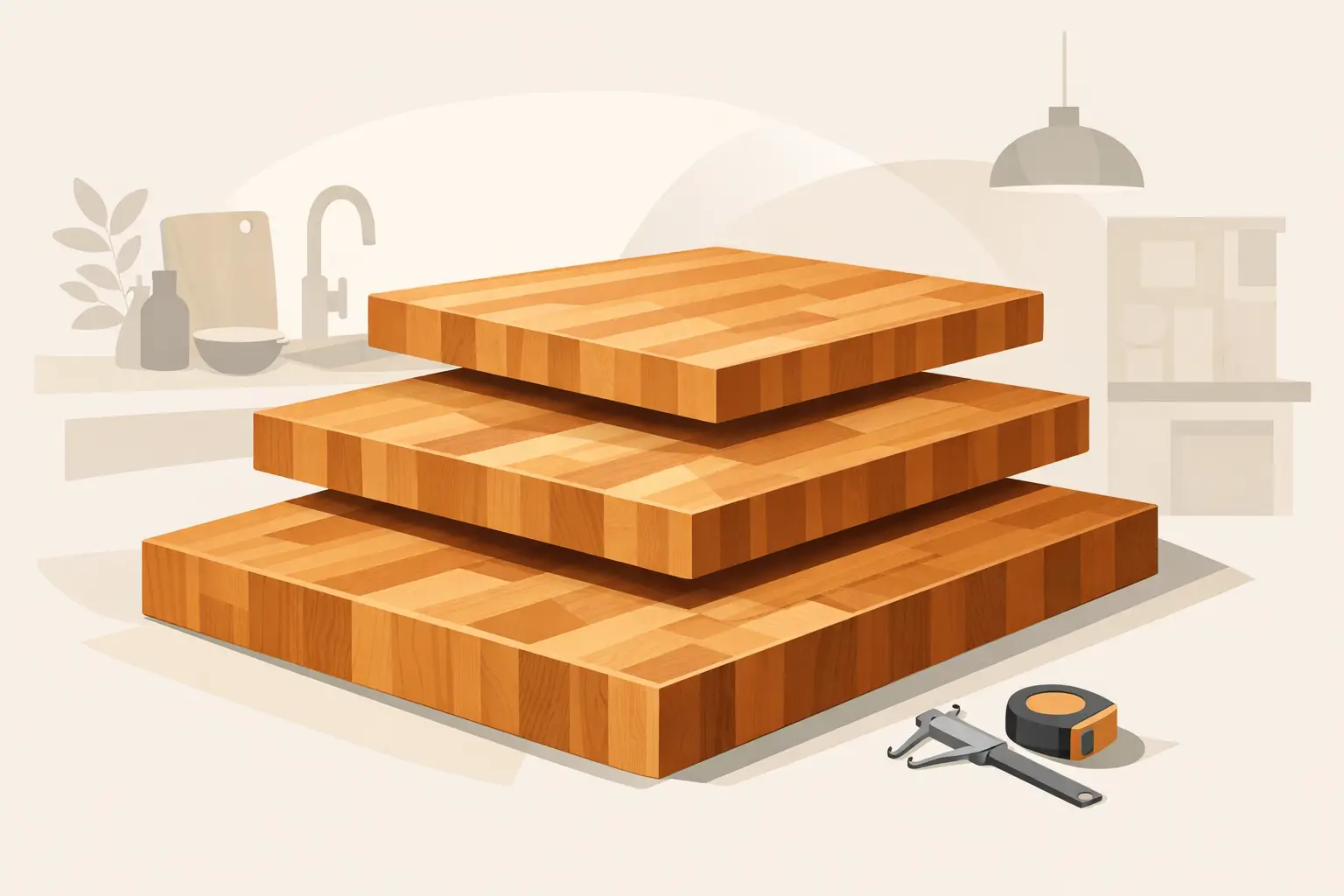
A butcher block top can look completely different depending on its thickness. A slim 1-inch top may feel clean and tailored in a laundry room, while a 2-inch maple island top becomes a substantial furniture piece in the center of the kitchen. If you are asking what thickness for butcher block countertops is right for your project, the answer comes down to how the top will be used, what supports it, and the look you want to bring into the room.
For most kitchen counters, 1.5 inches is the dependable middle ground. It provides real visual weight, holds up well over cabinets, and works with the standard countertop height homeowners expect. Still, there are good reasons to choose thinner or thicker wood in the right setting.
The Best Thickness for Most Kitchen Counters
A 1.5-inch butcher block countertop is the most versatile choice for standard base cabinets, kitchen islands, coffee bars, and work areas. It has enough material to look like a true hardwood countertop rather than a thin surface panel, and it gives you a solid edge profile without becoming unnecessarily heavy.
Standard base cabinets are generally 34.5 inches high. Once a 1.5-inch top is added, the finished counter lands at the familiar 36-inch working height. That is a practical reason this thickness is so common: it fits the way most kitchens are built without requiring cabinet modifications.
From a craftsmanship standpoint, 1.5 inches also gives a wood top enough presence to show off the species, grain pattern, and hand-finished character that make butcher block special. Whether you prefer warm walnut, clean maple, rich cherry, or a mixed hardwood look, the thickness helps the material read as solid wood from every angle.
When a 1-Inch Butcher Block Top Makes Sense
A 1-inch butcher block countertop is a smart choice when the top has consistent support underneath and the project calls for a lighter visual profile. It works especially well on a desk, built-in workspace, bathroom vanity, window seat, utility counter, or a small bar where every extra fraction of an inch affects the final height.
It can also be a good option for homeowners replacing an existing countertop without changing appliance clearances, backsplash height, or cabinet dimensions. A thinner top is easier to handle during installation and usually costs less because it uses less hardwood.
The trade-off is that 1-inch material has less stiffness across open spans. It should sit on well-built cabinets, brackets, or framing rather than bridge a wide unsupported space. It also offers less depth for decorative edge shaping and less material for future refinishing, though a properly cared-for solid wood top can still serve a home for many years.
For a standard cabinet run with a full plywood cabinet box beneath it, 1 inch can be perfectly appropriate. For a large island with seating, a long desk, or an open-leg table design, more thickness is usually the better investment.
Why Choose a 2-Inch Butcher Block Countertop?
A 2-inch butcher block countertop is built for projects where strength and visual impact matter most. This is the thickness that gives an island, dining table, or statement workstation a substantial, custom-built appearance. It feels intentional in a way thinner material cannot always match.
Thicker tops are a strong fit for islands with an overhang, especially when the butcher block extends beyond the cabinets for stools. The wood itself is not a substitute for proper brackets or legs, but extra thickness adds stiffness and helps the countertop feel more solid over a supported span.
A 2-inch top also works beautifully for freestanding furniture. Dining tables, workbenches, console tables, and large desks benefit from the heavier proportion. A thick hardwood slab on a simple base can become the focal point of a room without needing ornate details.
Keep weight in mind. A large 2-inch hardwood top can be very heavy, and installation may require extra hands, careful planning, and sturdy cabinetry or a well-built base. It will also cost more than a 1-inch or 1.5-inch top. For many projects, that added material is worth it. For a small vanity or shallow wall shelf, it may be more than the space needs.
Match Thickness to the Countertop’s Support
Thickness and support work together. A countertop should be properly supported regardless of how thick it is, but thicker wood offers more resistance to deflection when a top spans an open area.
For a countertop resting continuously on base cabinets, 1 inch to 1.5 inches is usually a practical range. Cabinet rails, side panels, and a level installation surface all help carry the load. If cabinets have large gaps, weak rails, or uneven tops, solve those structural issues before installing the wood.
For overhangs, use purpose-built countertop brackets, corbels, legs, or a steel support system sized for the depth and weight of the top. This matters most at seating areas. A 12-inch overhang is very different from an 18-inch or 24-inch overhang, and the right support is based on the specific layout rather than a one-size-fits-all rule.
For a floating desk or wall-mounted counter, do not rely on thickness alone. Strong hidden brackets anchored into wall studs are essential. A 1.5-inch top with quality steel brackets can be an excellent desk surface, while a 2-inch top may be the better visual choice for a more dramatic built-in.
Consider the Room’s Scale and Style
The right butcher block thickness should look proportional to everything around it. In a compact kitchen with narrow shaker cabinets and a light, simple design, a 1-inch or 1.5-inch top often feels balanced. In a large kitchen with a wide island, heavy pendant lights, and substantial cabinetry, a 2-inch top can better match the room’s scale.
Edge visibility matters, too. On a standard cabinet counter, the exposed front edge is one of the first details people notice. A thicker edge creates a bolder line and makes the countertop feel more furniture-like. A thinner edge feels more understated and can be ideal for modern, Scandinavian, or minimalist spaces.
Species can influence the visual result. Dark walnut has a naturally rich, weighty appearance, so 1.5 inches often carries plenty of presence. Pale maple can look crisp and refined at 1 inch, but it also looks striking at 2 inches when used for a large island or table. The best choice is not only about structural need. It is also about the proportion that makes you want to look at the finished piece every day.
Think About Sink, Cooktop, and Edge Details
Cutouts change the conversation. An undermount sink installation, for example, requires careful fabrication, sealing, and support around the opening. A thicker countertop gives more material around an edge and can make a sink area feel especially substantial, but proper sealing is what protects the wood from routine water exposure.
If you are installing a drop-in sink or cooktop, confirm the manufacturer’s cutout requirements before ordering. Leave enough material around openings, and plan for where seams, supports, and faucet holes will fall. Custom-made butcher block gives you the advantage of building around these details instead of trying to force a stock panel into place.
Thickness also affects edge profiles. A 1-inch top generally looks best with a small eased edge, slight round-over, or clean square profile. At 1.5 inches and 2 inches, there is more room for a softened edge or a custom profile that matches the cabinetry and overall style of the home.
Budget, Weight, and Long-Term Value
More thickness means more hardwood, more weight, and a higher price. That does not mean the thickest option is always best. The right purchase is the one that fits the project structurally and visually without paying for material you do not need.
If budget is tight, a 1-inch top on fully supported cabinets can still deliver the warmth and character of real wood. If you are building a forever kitchen island or a family dining table that will see daily use, stepping up to 1.5 or 2 inches can give the piece the durability and presence you had in mind from the start.
All solid wood countertops need reasonable care. Use a finish suited to the application, wipe up standing water, avoid placing hot pans directly on the surface, and allow the wood to move naturally with seasonal humidity changes. A quality handmade top is not disposable. It is a surface that can be maintained, renewed, and enjoyed as the home changes around it.
What Thickness for Butcher Block Countertops Is Right for You?
Choose 1 inch for supported, lighter-duty counters and built-ins where a slim profile or finished height is the priority. Choose 1.5 inches for most kitchen countertops and islands where you want the best balance of strength, appearance, and everyday practicality. Choose 2 inches for large islands, seating overhangs with proper support, tables, and statement pieces that deserve a heavier furniture-grade look.
At Tooill Cabinets, every custom wood surface is built around the actual project, not a generic shelf size. Bring your dimensions, support plan, and design vision to the conversation. The right thickness should feel natural in your space, solid under your hand, and worth coming home to for years.