
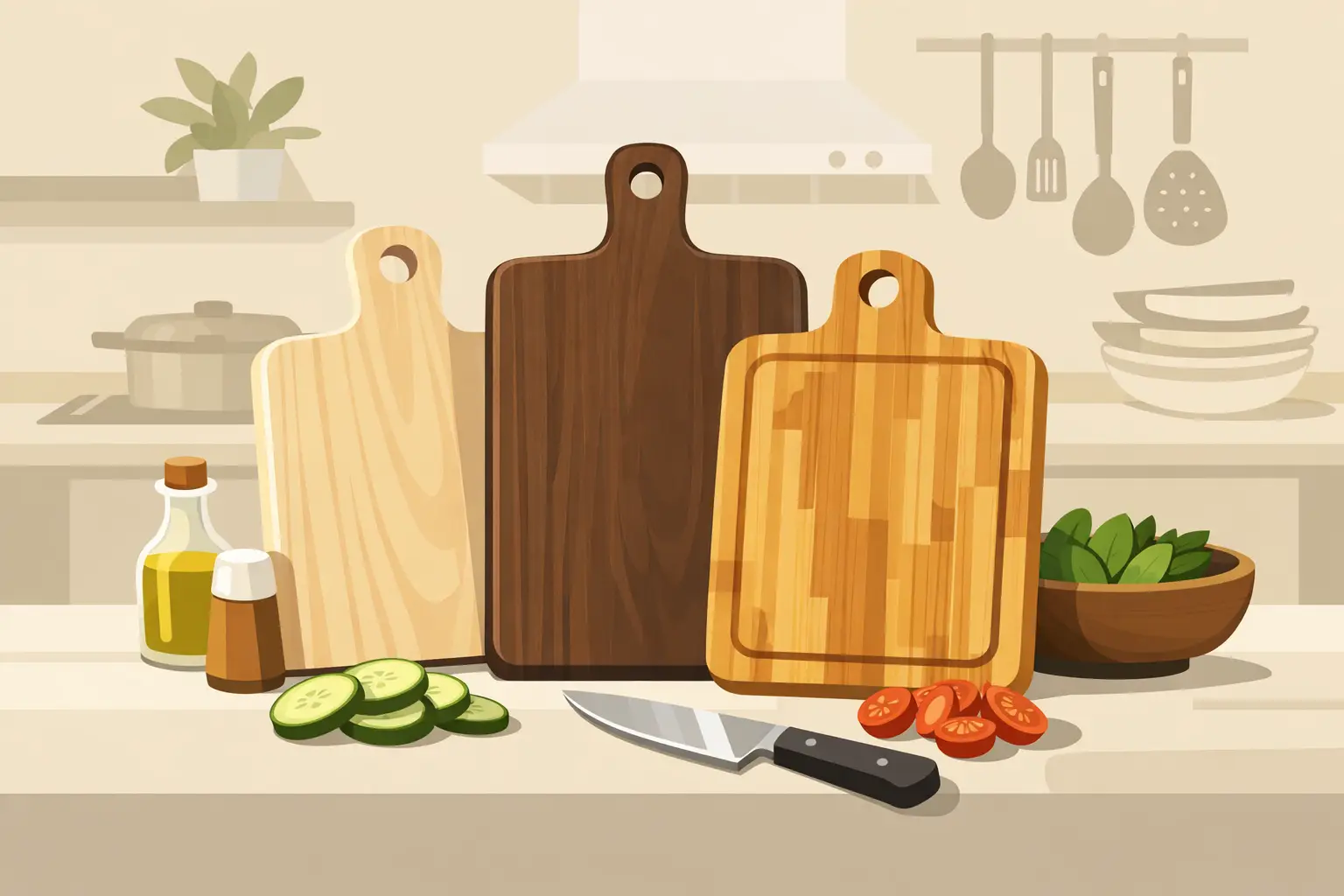
A cutting board lives at the center of everyday kitchen work. It sees sharp knives, raw ingredients, moisture, and frequent washing, so the material needs to do more than look good on the counter. When customers ask what wood is safest for cutting boards, the best answer is usually a dense, closed-grain hardwood with a food-safe finish and sound construction.
For most home kitchens, hard maple is the dependable standard. Walnut and cherry are also excellent choices, particularly when color and overall kitchen design matter. The right board is not simply the hardest wood available. It should be durable enough for daily prep, gentle on knives, easy to maintain, and made from materials you can trust.
What wood is safest for cutting boards?
Hard maple, also called sugar maple or rock maple, is widely considered one of the safest and most practical woods for cutting boards. Its grain is tight and relatively nonporous, which helps it stand up to moisture and repeated use. It is also hard enough to resist deep scoring while remaining kinder to knife edges than glass, stone, or plastic boards that have become heavily worn.
Walnut and cherry belong in the same trusted category. Both are hardwoods that have been used for quality kitchen pieces for generations. Walnut offers a deep, rich brown color and a slightly softer cutting surface than maple. Cherry begins lighter and develops a warmer reddish-brown patina over time. Neither is quite as hard as maple, but both perform well when the board is properly built, finished, cleaned, and maintained.
The safest choice depends partly on how you use your board. A large end-grain maple butcher block can handle serious knife work. A walnut serving and prep board may be the better fit for a kitchen where appearance matters just as much as daily chopping. For a custom board, the goal is to match the species, construction, and dimensions to the way you actually cook.
Why closed-grain hardwoods are preferred
A board’s grain structure matters as much as its species. Closed-grain woods have smaller pores, which makes them less likely to hold onto moisture and food residue than very open-pored woods. That does not make any wooden board maintenance-free, but it does make cleaning and long-term care more manageable.
Maple has a fine, subtle grain that works especially well for cutting surfaces. Cherry and walnut also have a smooth, refined texture. These woods are stable, attractive, and proven in real kitchens.
Wood also has a practical advantage over hard synthetic surfaces: a well-made wood board can be sanded and renewed when it eventually shows years of honest use. That makes a solid hardwood board a long-term kitchen tool rather than a disposable purchase.
The best cutting board woods, compared
Hard maple: the all-around workhorse
Hard maple is the choice we recommend most often for customers who want a durable everyday cutting board. It has a clean, light appearance that works with nearly any kitchen, from traditional butcher block counters to modern painted cabinetry. Its density helps it resist knife marks, and its closed grain makes routine care straightforward.
The trade-off is that hard maple can show stains more easily than darker woods, especially if it is left wet or used regularly with deeply colored foods. That is normal for a working cutting board, not a sign that it is unsafe. Regular oiling helps reduce moisture absorption and keeps the surface looking its best.
Walnut: dark, warm, and easy on knives
Walnut is a favorite for homeowners who want a cutting board that also looks like a finished piece of woodwork. Its rich color can hide minor stains and adds warmth to a kitchen, dining table, or charcuterie spread. It is somewhat softer than hard maple, which can be easier on knife edges.
Because walnut is softer, it may pick up knife marks sooner in a high-use kitchen. For many people, that is part of the character. If you want a dark board for daily prep, choose a board with enough thickness and quality construction so it can be maintained for years.
Cherry: classic color that gets better with age
Cherry is another safe, beautiful choice for cutting boards. It is moderately hard, fine-grained, and naturally smooth. Fresh cherry often has a lighter amber tone, then gradually deepens as it is exposed to light and air.
That changing color is part of cherry’s appeal, but it is worth knowing before you buy. If you want your board to stay pale and uniform forever, maple is the better match. If you appreciate a board that develops personality over time, cherry is hard to beat.
Woods that deserve more caution
Not every attractive wood belongs on a food-prep surface. The main concerns are toxicity, porosity, excessive softness, instability, and unknown sourcing.
Exotic species can be especially tricky. Some woods are known to cause skin or respiratory irritation during woodworking, and their safety for repeated food contact may be unclear. A beautiful slab does not automatically make a suitable cutting board. If a species is not commonly used for food-prep boards and the maker cannot clearly explain its suitability, choose a proven domestic hardwood instead.
Very soft woods, including pine, cedar, and fir, are generally poor choices for cutting boards. They dent easily, absorb moisture more readily, and can retain strong odors or resins. They may be perfectly appropriate for shelves, wall accents, or decorative serving pieces, but they are not ideal for knife work.
Oak and ash are strong hardwoods, yet their more noticeable open pores make them less common for cutting boards. They can be used with careful finishing and upkeep, but maple, walnut, and cherry are usually simpler choices for a kitchen prep surface.
Bamboo is often marketed as an eco-friendly board material, but it is technically a grass made into boards through laminating. Quality varies widely, and many bamboo boards contain a significant number of glue lines. A well-made bamboo board can work, but a solid hardwood board offers a more traditional, repairable surface with fewer unknowns about construction.
Safe wood is only half the equation
Even the best species can become a poor cutting surface if it is made with unsuitable glue, coated in a film finish, or neglected after use. For a board meant for food prep, look for food-safe adhesive and a penetrating conditioner such as food-grade mineral oil, often paired with beeswax or a similar board wax.
Avoid cutting directly on boards finished with thick varnish, lacquer, polyurethane, or decorative paint. Those finishes may be appropriate for a tabletop or serving tray, but repeated knife work will eventually cut through them. A cutting board should be finished with a treatment that can be refreshed as the surface dries.
Do not use cooking oils like olive, vegetable, or canola oil to condition a board. They can oxidize over time and develop unpleasant odors. Food-grade mineral oil is stable, affordable, and easy to reapply.
Construction matters, too. A well-built board should feel solid and remain flat on the counter. End-grain boards are popular because the wood fibers face upward, allowing knife edges to slip between fibers rather than cutting across them. Edge-grain boards are also durable, often more affordable, and excellent for everyday use. Neither style is automatically safer than the other. Good lumber selection, quality glue-up work, and proper care matter more.
How to keep a wood cutting board safe
A hardwood board needs simple, consistent care. Wash it by hand with mild soap and warm water, then dry it promptly on its edge so both sides can air out. Never soak it in the sink or run it through the dishwasher. Extended water exposure can cause swelling, warping, and eventually glue-joint failure.
Oil the board whenever it looks dry, feels rough, or begins absorbing water quickly. In a busy kitchen, that may be every few weeks. In a lighter-use kitchen, it may be every month or two. Apply mineral oil generously, let it soak in, and wipe away the excess. A board wax can add another layer of moisture resistance.
For raw meat, poultry, or fish, clean promptly and thoroughly after use. Many cooks prefer to keep a separate board for proteins and another for produce, bread, and ready-to-eat foods. That habit reduces cross-contamination concerns regardless of whether the board is wood or plastic.
If deep cuts, stains, or roughness appear over time, a solid wood board can often be lightly sanded and refinished. That is one reason handcrafted hardwood boards remain a smart investment. At Tooill Cabinets, the focus is on building real wood surfaces meant to be used, maintained, and appreciated for years.
The safest cutting board is one made from a proven hardwood, finished for food contact, and cared for like the hardworking kitchen tool it is. Choose hard maple when you want maximum everyday durability, walnut when you want rich color, or cherry when you want a board that gains warmth with age. Then use it well, keep it dry, and let the craftsmanship earn its place in your kitchen.